
Core Capability for Upper Atmospheric Structure Analysis
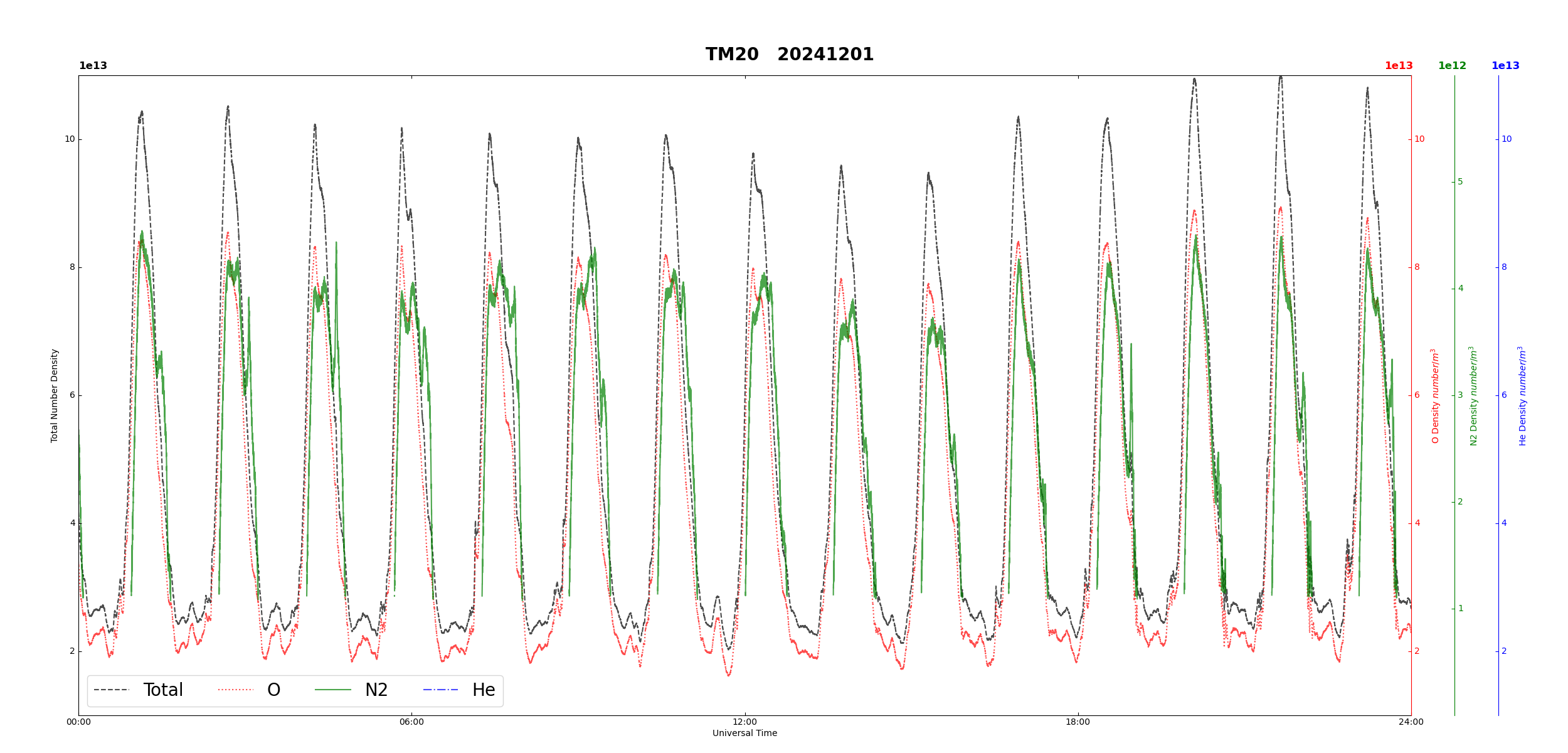
Atmospheric composition structure determines the physical properties, chemical reaction processes, and energy transfer mechanisms of the thermosphere. It serves as the foundation for understanding upper atmospheric evolution and the response of the space environment to external disturbances. Orbital atmospheric composition data provide critical support for multi-component thermospheric modeling and for improving space environment prediction capabilities.
Application
 High-Precision Drag Modeling
 Spacecraft Material Design
 Space Weather Research
 Earth Atmospheric Studies
Data Sheets
| L2 | Orbital Atmospheric Composition |
|---|---|
| Contents | The orbital atmospheric composition product provides along-track number density data of different neutral gas species, together with auxiliary parameters. The product dataset includes time, longitude, latitude, altitude, local solar time, helium number density, atomic oxygen number density, molecular nitrogen number density, total number density, and quality flags. |
| File Naming | atmDns_DQCF_LLL.YYYYMMDD_HHMMSS_UUUUU_L2.txt |
| File Format | txt |
| Data Domain Information | 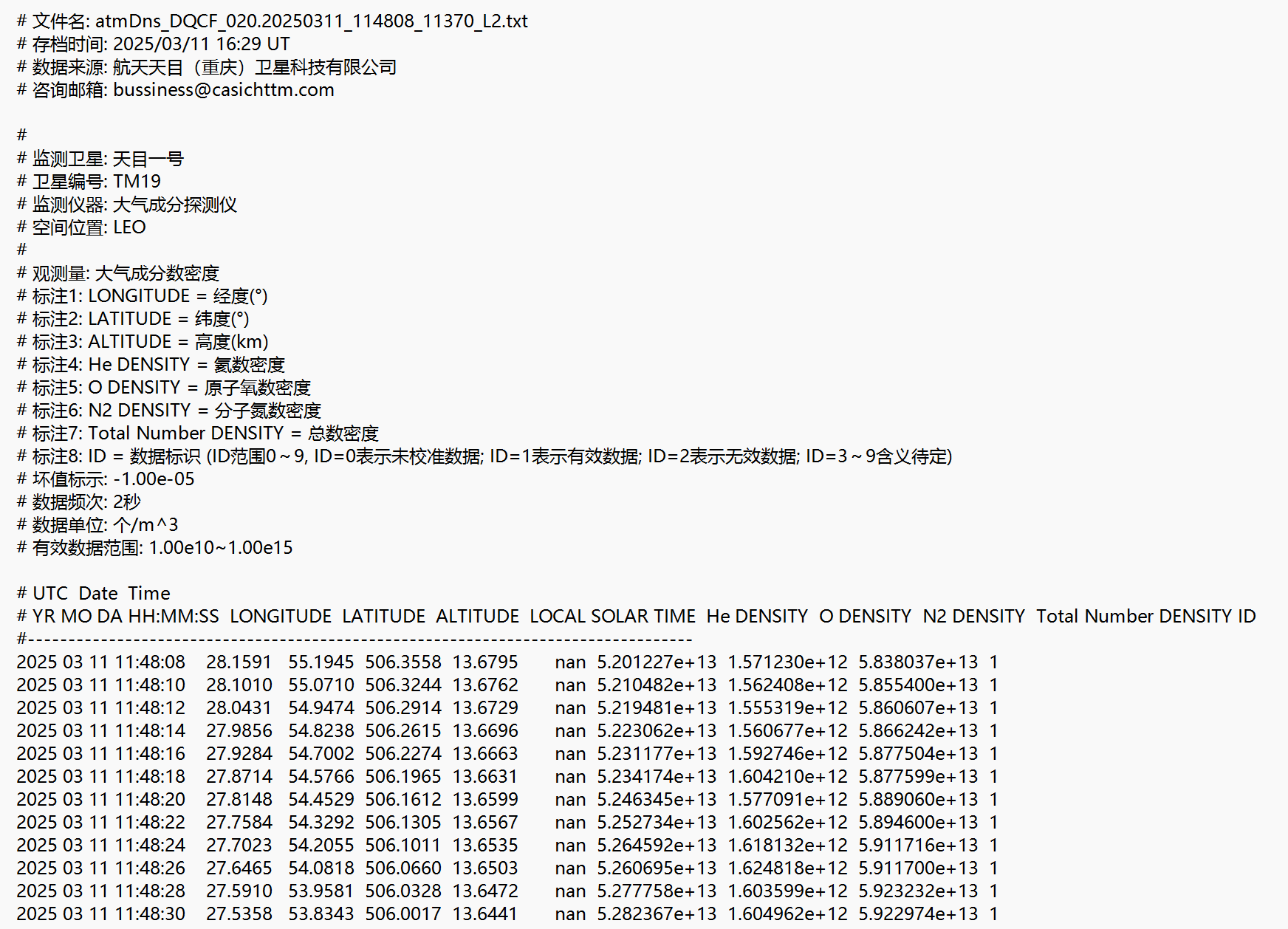 Columns 1–6 represent UTC time in the format YYYY MM DD hh mm ss. Column 7 represents geographic longitude in degrees. Column 8 represents geographic latitude in degrees. Column 9 represents orbital altitude in kilometers. Column 10 represents local solar time in hours. Column 11 represents helium number density. Column 12 represents atomic oxygen number density. Column 13 represents molecular nitrogen number density. Column 14 represents total number density. Column 15 represents the data flag (ID range: 0–9; ID = 0 indicates uncalibrated data; ID = 1 indicates valid data; ID = 2 indicates invalid data; ID = 3–9 reserved for future definition). |
| Technical Specifications | Sampling rate: 2 seconds Measurement accuracy: < 10% |
| Daily data growth from a single satellite | About 5MB |
| Image | 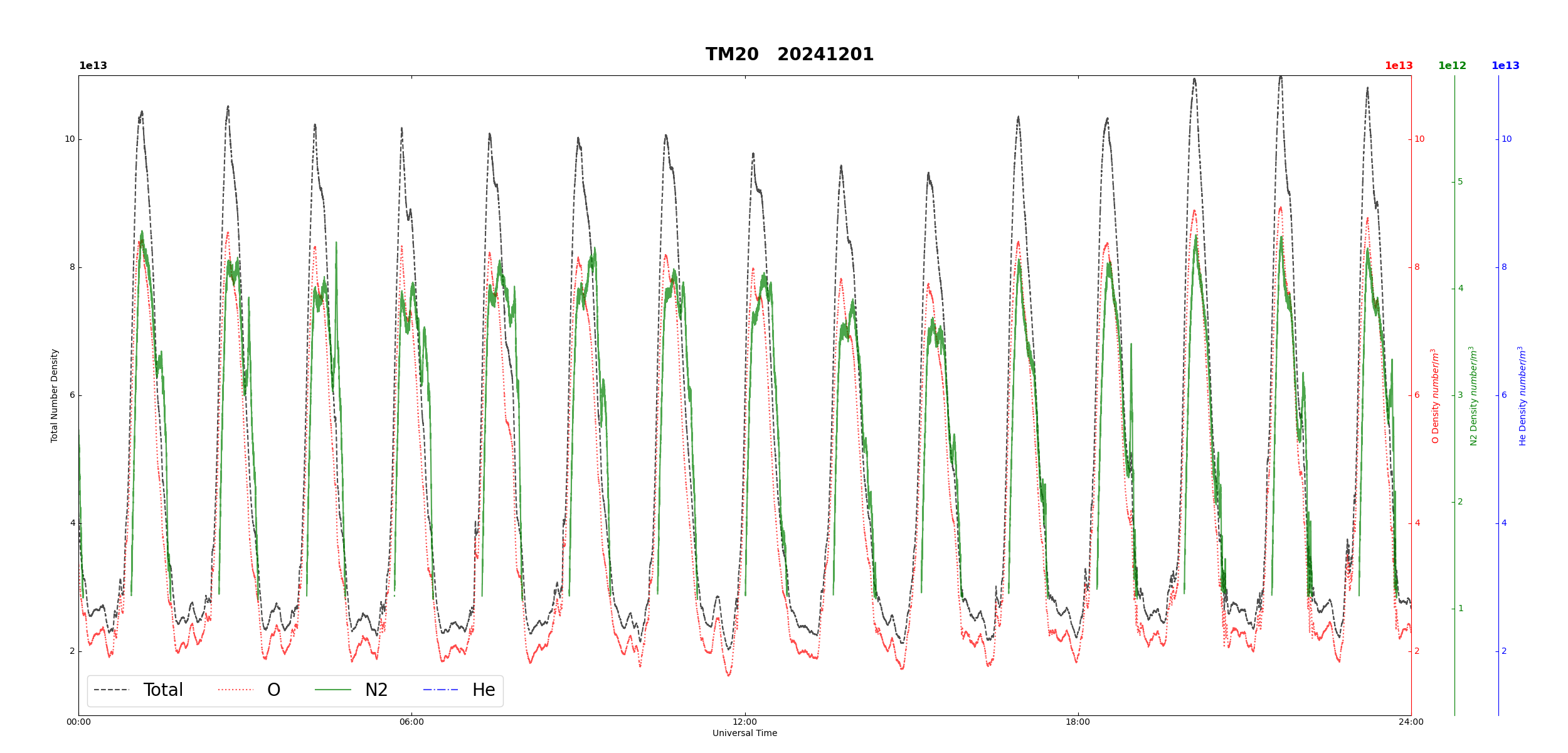 |
| L1 | Level 1 Orbital Atmospheric Composition |
|---|---|
| Contents | The Level I orbital atmospheric composition product provides along-track measurements of sampling chamber pressure, sampling chamber temperature, and auxiliary data for different neutral gas species. The product dataset includes time, total gas pressure in the sampling chamber, partial pressure of helium, partial pressure of atomic oxygen, partial pressure of molecular nitrogen, sampling chamber temperature, electron emission monitoring, filament status monitoring, power supply monitoring AV1, power supply monitoring V2, and spacecraft attitude quaternions. |
| File Naming | atmPreTem_DQMD_LLL.YYYYMMDD_HHMMSS_UUUUU_L1.txt |
| File Format | txt |
| Data Domain Information |  Columns 1–6 represent UTC time in the format YYYY MM DD hh mm ss. Column 7 represents the total gas pressure in the sampling chamber (unit: Pa). Column 8 represents the partial pressure of helium (unit: Pa). Column 9 represents the partial pressure of atomic oxygen (unit: Pa). Column 10 represents the partial pressure of molecular nitrogen (unit: Pa). Column 11 represents the sampling chamber temperature (unit: K). Column 12 represents electron emission monitoring (unit: V). Column 13 represents filament monitoring (unit: V). Column 14 represents power supply monitoring (unit: V). Column 15 represents spacecraft attitude quaternion q0. Column 16 represents spacecraft attitude quaternion q1. Column 17 represents spacecraft attitude quaternion q2. Column 18 represents spacecraft attitude quaternion q3. |
| Daily data growth from a single satellite | About 7MB |